과학ㆍ컴퓨터ㆍ기술ㆍ공학
AI translated from Korean · View 한국어 original
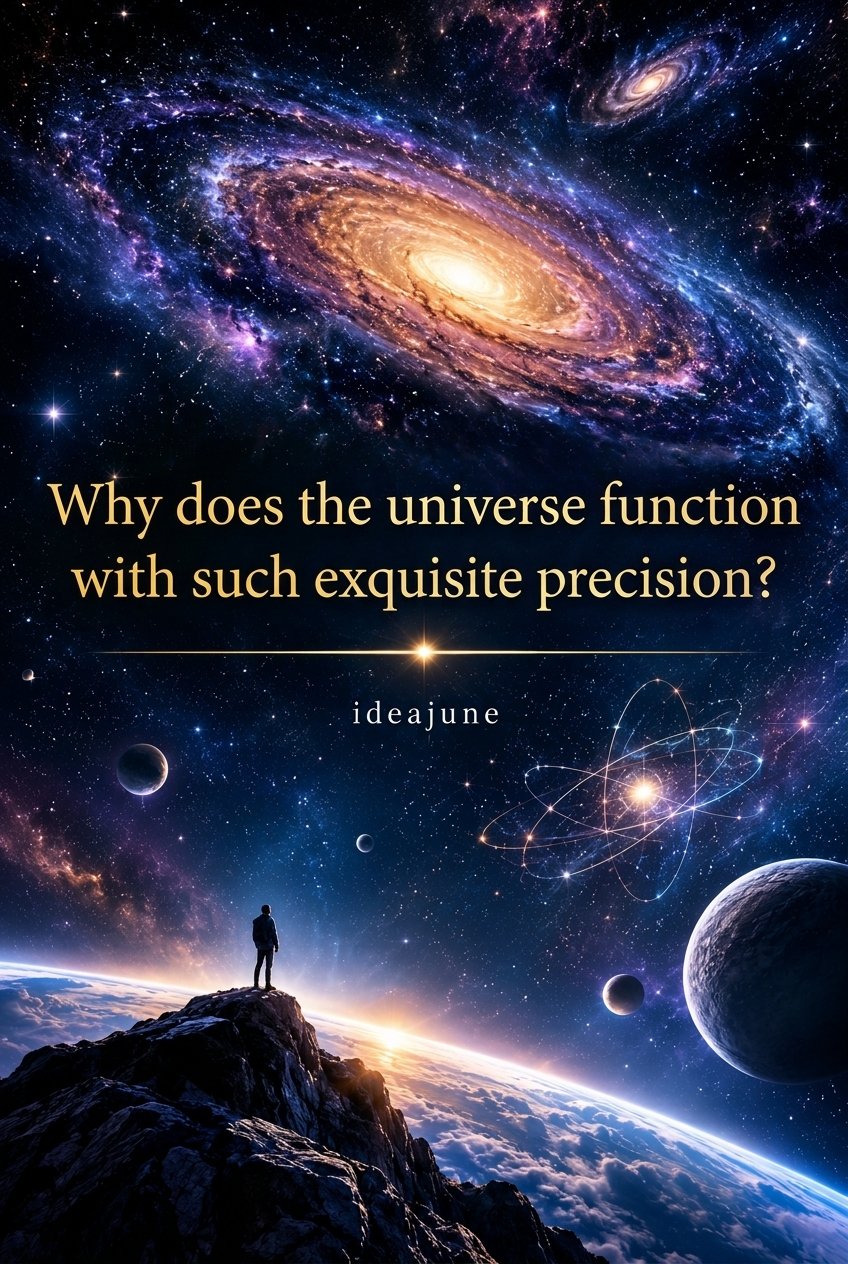
Why does the universe function with such exquisite precision?
1,000con1,000KRW
- Length73Page · approx. 33minutes
- FormatShortbook PDF
- Upload date2026.11.18
Available in
I
ideajuneContent 32
Profile
About this content
This is a guide for readers who have looked up at the night sky and thought, 'How can it be so harmonious?' It serves as a companion for general readers with a basic grounding in physics and cosmology and for anyone who wants to sharpen scientific or philosophical questions. It begins by linking the universe's vast scenes with familiar metaphors and careful observations.
The preface and first chapter explain the universe's birth and expansion, and how the cosmic microwave background, the first light after recombination, led to today's structures. One striking image is a map of the tiny temperature fluctuations left by that first light at recombination. Chapter two treats physical constants and the problem of fine tuning, offering concrete thought experiments about how nucleosynthesis would have changed if the strong force or the speed of light had been even slightly different.
Chapters three and four explore, in turn, how stars and galaxies forge elements and scatter raw materials through the cosmos, and how that process produces environments in which planets and life can arise. Each chapter lays out stage-by-stage scenes of nucleosynthesis and poses the question, 'Under what conditions will a planet nurture life?' Chapter five compares the multiverse hypothesis with other explanations for fine tuning, distinguishing what can be supported by observation from what remains hypothetical.
After reading, you will no longer take the universe's intricacy as mere wonder; you will have criteria for separating fact, hypothesis, and philosophical interpretation. The key scenes and thought experiments will leave you with a mental toolkit: a clear grasp of the roles physical constants and stars play, and the means to frame your own fundamental questions.
About the author
I am ideajune, a writer who observes the world, asks questions, and finds new possibilities in the familiar. I explore a wide range of fields, from history and philosophy to science and technology, from human psychology to future societies, and I write to unpack complex ideas in an accessible, engaging way.
Writing books is not merely the transmission of knowledge; it is a journey that helps readers discover new perspectives on the world. I recast the wisdom of the past in today’s language and look for future possibilities within present problems. With ceaseless curiosity and imagination, I connect knowledge and life, and I hope a single book can become the starting point for new thoughts and actions.
Writing books is not merely the transmission of knowledge; it is a journey that helps readers discover new perspectives on the world. I recast the wisdom of the past in today’s language and look for future possibilities within present problems. With ceaseless curiosity and imagination, I connect knowledge and life, and I hope a single book can become the starting point for new thoughts and actions.
Contents
Prologue · The First Time I Thought of Space
1. After the Big Bang, Order Is Born
2. Invisible Rules: Physical Laws and Fundamental Constants
3. Stars and Galaxies: Cosmic Factories Rise
4. Life and Consciousness: The Universe Looks at Itself
5. Chance or Necessity: Fine-Tuning and the Multiverse
Epilogue · Questions We Can Ask in the Face of an Intricate Universe












.jpg)


.jpeg)







.jpg)


Comments 1
Gooood